After 30 years behind the editor’s desk, I’m taking you inside a real deadline day to reveal what happens when your media pitch lands in an editor’s inbox—and what makes one story stand out among hundreds.
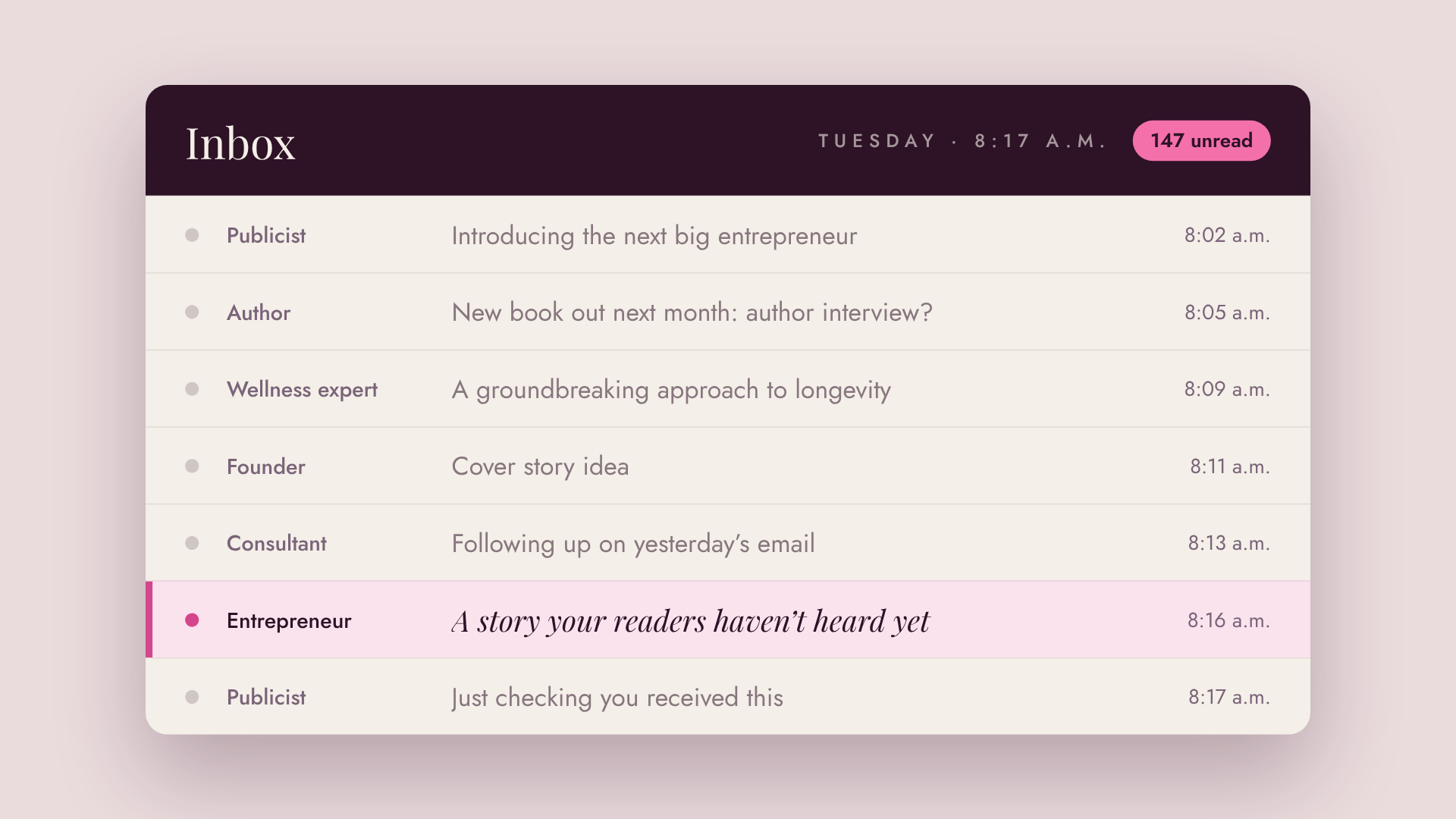
It’s 8:17 a.m. on a Tuesday.
I’ve barely put my coffee down, and my inbox is already filling up.
A publicist wants to introduce me to the next big entrepreneur. An author has a new book coming out. A wellness expert has discovered what she believes is a groundbreaking approach to longevity. Someone wants to be on our cover. Someone else is following up on an email they sent yesterday.
And somewhere in that inbox is probably a genuinely great story.
The problem?
I have a magazine to get out the door.
Welcome to the other side of your media pitch.
For more than three decades, I’ve worked behind the editor’s desk at major consumer publications, most recently as Editor-in-Chief and Chief Content Officer of SUCCESS® magazine. I’ve reviewed thousands upon thousands of pitches, worked with some of the biggest names in business and entertainment, and made the decisions about which stories deserved valuable editorial real estate.
And if there’s one thing I wish more people understood about pitching the media, it’s this:
Your pitch doesn’t arrive in a quiet room where an editor is patiently waiting to discover you. It arrives in the middle of someone else’s very busy day.
That distinction matters more than you might think.
9:00 a.m. — The Inbox Is Only Part of the Job
By nine, I’m already juggling several conversations.
A writer needs clarification on a feature. The art director has questions about a cover image. Someone on the business side wants to discuss an upcoming partnership. We’re reviewing headlines, managing production schedules, and making sure the stories we’ve already committed to are moving forward.
Meanwhile, more pitches are arriving.
Here’s something people outside publishing don’t always realize: reading unsolicited pitches is just one small part of an editor’s responsibilities.
And on deadline days, it isn’t necessarily the most urgent one.
That doesn’t mean your email isn’t important. It means you’re competing with an entire publication’s priorities.
So, when I open a pitch, I’m not looking for a lengthy introduction or an impressive collection of credentials.
I’m looking for a reason to keep reading.
Quickly.
10:30 a.m. — You Have My Attention. For Now.
Let’s say your subject line catches my eye.
That’s a good start.
I open your email.
The first paragraph tells me you’ve been in business for 20 years, you’ve won several awards, you’ve appeared on numerous podcasts, and you’re passionate about helping people succeed.
Wonderful.
But what’s the story?
I can’t tell you how many times I’ve asked that question over the years.
It’s not that I don’t appreciate your accomplishments. I do. I’ve spent my career interviewing extraordinary people.
But an editor isn’t simply looking for extraordinary people.
We’re looking for extraordinary stories that make sense for our readers.
There’s a difference.
If I have to dig through four paragraphs to understand what you’re proposing, chances are I’m already moving on.
Not because I’m dismissing you.
Because I have another meeting in five minutes.
11:45 a.m. — The Story That Makes Me Stop
Then another email comes in.
It’s short. Specific. Relevant.
The person pitching has clearly read the magazine. They understand our audience. They’ve identified a timely issue and offered a perspective I haven’t seen a dozen times already.
Better yet, I can immediately imagine how the story might look on the page.
Now we’re getting somewhere.
I might forward it to a senior editor. I might flag it for an upcoming editorial meeting. I might ask someone on my team to research the person or idea.
Or I might simply leave it unread in a folder for a few days until I have the breathing room to revisit it.
That last part is important.
Silence doesn’t always mean rejection.
Sometimes it means we’re considering the idea. Sometimes the timing isn’t right. Sometimes we’re already working on a similar feature.
And yes, sometimes it means no.
But you can’t possibly know which one it is from the other side of the inbox.
1:00 p.m. — The Editorial Meeting Changes Everything
Here’s where things get interesting.
Let’s say your pitch makes it into our editorial discussion.
You might think that’s the finish line.
It isn’t.
Now we’re asking a different set of questions.
Does this story fit the issue we’re planning? Have we covered this topic recently? Is there a stronger angle? Do we have the right writer? Is there enough substance for a full feature, or would it work better as a shorter piece?
And perhaps most importantly, why should our readers care right now?
I’ve sat through countless editorial meetings where a promising idea evolved into something entirely different.
Sometimes a pitch that arrived as a proposed profile became a broader trend story.
Sometimes an expert who wanted a standalone feature became one of several sources in an article.
And sometimes a terrific idea simply didn’t fit our editorial calendar.
That’s publishing.
A good pitch can open the door, but it doesn’t dictate what happens once you’re inside.
3:30 p.m. — The Follow-Up Arrives
By midafternoon, I’m back in my inbox between meetings.
And there it is.
“Just checking to see if you received my email.”
I received it.
Probably.
But I may not have had time to evaluate it properly.
This is where I encourage people to exercise a little patience.
Following up is perfectly reasonable. In fact, a thoughtful follow-up can be helpful.
But sending repeated messages within a day or two rarely improves your chances.
Editors are working against deadlines you may know nothing about.
Give them room to do their jobs.
And when you do follow up, make it useful. A new development, an updated statistic, or a timely connection to something happening in the news gives me a reason to reconsider your idea.
Another copy of the same email doesn’t.
5:45 p.m. — The Decision You May Never Hear About
The day is winding down.
At least officially.
There are still pages to review, approvals to give, and a production team waiting on decisions.
I return to the inbox one more time.
Some pitches get forwarded.
Some get saved.
Some get a response.
Many don’t.
And I know that can be frustrating, especially when you’ve put genuine thought and effort into reaching out.
But I want you to understand something.
An editor’s no is not a verdict on your worth, your business, or your expertise.
It may simply mean the idea wasn’t right for that publication at that moment.
I’ve passed on perfectly credible people because the editorial fit wasn’t there.
I’ve also revisited ideas months later when a new issue, theme, or conversation made them relevant.
Timing matters.
So does understanding how the decision is made.
What I Want You to Remember
After all those years reviewing pitches, interviewing thousands of people, and making editorial decisions, I’ve come to appreciate one quality above almost everything else.
Consideration.
The people who understood our audience, respected our deadlines, and made an effort to bring us something genuinely useful stood out.
They weren’t always the most famous.
They didn’t necessarily have the biggest PR agencies.
And they certainly weren’t always the ones sending the most emails.
They were the people who understood that good journalism begins with a good story.
Today, as I teach entrepreneurs, executives, and thought leaders what I learned behind the editor’s desk, I find myself returning to that same lesson.
Before you hit Send, take one final look at your pitch.
Forget your title for a moment. Forget your credentials. Forget how badly you want the coverage.
Imagine you’re the editor, sitting at that desk, with a deadline approaching and another hundred emails waiting.
Would your story make you stop?
If the answer is yes, you’re already thinking differently.
And that’s a very good place to start.
Want to see your pitch through an editor’s eyes before you send it? Explore my digital guide, The Editor’s Pitch Checklist™, at KerrieLeeBrown.com.